
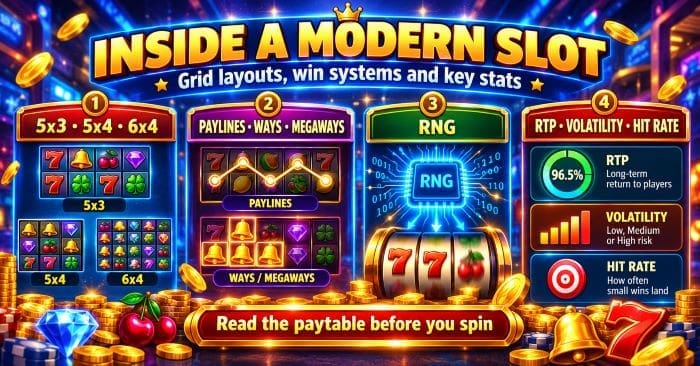
The first time I seriously examined a video slot versus just gazing at it while watching my bankroll dwindle, I’d already played thousands of rounds. That’s sort of embarrassing to confess. I knew which types of slots I enjoyed and which ones seemed “cold,” yet I wouldn’t have been able to tell you why a certain 5×3 game paid out rarely but frequently, while another would go cold for 200 spins and then dump a feature worth 300 times the bet. As soon as I began pulling open the information windows, studying the pay tables correctly, and understanding how the math actually worked, the whole experience suddenly became far less mysterious and infinitely more fascinating.
Therefore, the above is essentially the guide I wished someone had provided me with back then. In this article, we’ll dissect a modern video slot, part-by-part: the grid you see, the reel strips you cannot see, the random number generator (RNG) that dictates everything, the symbols, the win systems, the features, and the numbers hidden within the game rules. If you’ve ever asked yourself how video slots operate “underneath,” or what differentiates a video slot from a classic slot other than the flashy graphics, this guide should provide an overview of both.
Start with the grid: reels, rows & the window you see
All online video slots begin with a grid. The vertical columns are known as reels. The horizontal rows are just that – rows. The combination of both creates the grid that is displayed to you. Each spot within that grid represents a potential location for a symbol to land.
I find people consistently confuse the terms ‘reels’ and ‘rows’, so let me explain it in perhaps the simplest manner possible. What are reels in a slot machine? Columns that rotate. In an old mechanical machine, reels were literally physical drum(s); in a modern video slot they’re columns of symbols generated by software. What are rows in a slot machine? Horizontal lines across those columns. A column rotates vertically; a row simply refers to the number of symbols visible on each column when it stops rotating.
Hence, slot layouts are represented as reels x rows.
5×3, 5×4 and 6×4 layouts explained
The 5×3 slot layout is the “comfort food” of the slot world. Five reels, three rows, fifteen spots available to display on your screen. This type of layout became the standard for video slots in the late 1990s and 2000s and remains prevalent today due to simplicity of viewing, suitability for mobile devices in either portrait or landscape orientation, and familiarity among designers who understand how to create balanced mathematics in such layouts. Typically, a 5×3 game offers between 10-25 paylines or utilizes 243 ways-to-win (i.e., 2^15).
The 5×4 slot layout introduces an additional row – four rows total. Instead of displaying fifteen spots on-screen, Twenty will be displayed. Although seemingly minor, adding an additional row provides designers with space to add more paylines (typically forty-five to fifty) or increase the ways-to-win (to 1024, i.e., 2^10). Additionally, having an additional row will make visualizing stacked symbols or tall wilds seem much more dramatic. Not surprisingly, games utilizing a 5×4 layout may feel busier compared to their counterparts (due to greater opportunities for forming small wins based upon increased space for creating winning combinations).

A 6×4 slot layout takes this approach to an extreme: Six reels and four rows and Twenty-four spots available for display. Given the greater complexity of the layout, games utilizing Six reels commonly utilize a ways-to-win format or cluster-based formats for payouts. Creating one hundred logical paylines across a Six-reel/ four-row grid quickly becomes difficult.
How many reels and rows do video slots have?
Simple answer: usually Five reels and three or four rows.
Longer answer: whatever a designer desires. Games utilizing Six reels are extremely popular today.
Seven-reel games and larger grids do exist. Today, numerous video slots do not have a predetermined grid size. While older Megaways-style slots dynamically altered the number of rows per reel every single spin, numerous modern slots allow for changing grid sizes based upon user input (e.g., expansion of the grid during a bonus round based upon collection of symbols).
Consider “5×3” as merely a reference point rather than a governing body.
Behind each reel is a reel strip that can never be seen
While the visible grid explains part of the story regarding the operation of video slots; behind each reel exists a reel strip – the entire sequence of symbols that could potentially be displayed by that reel, arranged in a predetermined order. Therefore, when a reel appears to “stop”, what you’re witnessing is merely a very brief segment of this strip – typically three or four symbols wide – depending on how many rows the game contains.
Historically, mechanical three-reel machines utilized a physical reel strip – usually approximately Twenty-two stops per reel. The limitations placed upon jackpots in relation to frequency was therefore governed strictly by physical constraints: limited number of physical stops available on each reel.
Virtual reels & weighted symbols
The solution arrived in the mid-1980s via the introduction of virtual reel mapping (telnaes’s 1984 patent is generally cited as the seminal work on this subject). Essentially, the underlying software simulates a reel strip containing many more positions than the actual physical strip; multiple positions on this simulated strip correspond to the same visible symbol. Conversely, blank positions and low-symbol positions are assigned many more positions on this virtual strip than high-symbol positions (such as a jackpot symbol).
Weighted symbols defined
Frequency of occurrence on a virtual strip is completely independent of frequency of occurrence on the visible strip. A cherry may appear just as often as a seven on the visible strip while appearing dozens of times more frequently. Modern online slots do not contain physical reels; therefore, all are virtual. However, similar principles govern both generations. Game designers retain control over frequency of occurrence on each virtual strip; although it is common practice for designers to create separate virtual strips for base-game play and for free-spins play – hence why features can appear to be so dissimilar from regular play.
Reel stop positions defined
Each position on a reel strip has a unique number. For example, if reel one consists of sixty positions, stop positions for this reel can range from zero to fifty-nine. Ultimately, a spin result is simply a series of stop positions – one stop position per reel. After determining stop positions for each reel (with respect to their respective virtual strips), the game then identifies the corresponding symbols at and proximal to these positions to populate the grid; subsequently determines whether any winning combinations exist based upon comparison to applicable payout criteria.
Random number generator (RNG) in video slots explained
The random number generator (RNG) is essentially the brains of the operation. More precisely, virtually all RNGs used in online gaming environments are pseudo-random number generators (PRNGs) – algorithms designed to generate sequences of pseudo-random numbers that mimic randomness and start from an initial “seed value”. PRNGs refresh themselves with entropy from unpredictable external inputs so as to avoid predictable outputs.
How does RNG determine reel positions?
For most applications, when you initiate a spin request on an online game, it generates random numbers – each scaled to represent one stop position per reel strip (thus effectively assigning an output mapping immediately upon receiving a spin request). In general, this occurs prior to initiating animation related to spinning reels and subsequent pause prior to revealing results – typically as part of communication between your client application and provider servers. All visuals witnessed post-spin request, including animated spinning reels, slow-down, and dramatic pauses associated with specific reels, are theatrical elements. Great theatre.
Why independent spins matter so much
Independent spins ensure that each spin is computed independently; thus, regardless of previous losses or wins experienced while playing that particular game (or others), neither are taken into consideration nor does the game “warm-up” after large hits. Early on in my development as a player, I wasted an embarrassing amount of time changing games due to one game feeling “tight.” There was no reason for it; I perceived patterns in noise.
Video slot symbols explained from the bottom of the pay table upward
When reels cease rotation, symbols ultimately decide what transpires next. Standard symbols fall into two categories. Low-paying symbols consist primarily of card suits (10-J-Q-K-A) or simple gemstones and fruits. These occur often but award relatively little currency. Higher-paying symbols comprise thematic artwork: the pharaoh, dragon, treasure chest, etc. Higher paying symbols occur less frequently than lower paying symbols and pay considerably higher amounts than their lower-paying counterparts.
Wild symbols in video slots explained
Wild symbols substitute for other symbols thereby allowing completion of winning combinations. That’s what defines wilds. With few exceptions most wilds cannot act as replacements for scatters or bonus symbols; however this will explicitly state this in your pay table.
Modern games love providing wilds with added functionality. Expanding wilds extend across their entire reel. Sticky wilds remain stationary until additional spins pass; usually during free spin rounds. Walking wilds move left-right along each spin while triggering respins as they progress. Some wilds possess multipliers whereby any wins they contribute toward completing will be doubled/tripled. My ability to assess a new game is greatly influenced by behavior exhibited by wilds; specifically where money resides.
Scatter symbols in video slots explained
Scatters are symbols that do not require alignment along any specified line. three (or four) scatters anywhere on your grid will activate your bonus round; usually free spins. Some Scatter symbols award prizes regardless of presence elsewhere on your grid, although typically smaller than free spins awards. Separate bonus symbols sometimes serve as alternative mechanisms for activating distinct features (as opposed to free spins), e.g., pick-me games.
Cash symbols & collect symbols
More recent iterations of video slots have created families of feature symbols that provide various functionalities. Cash symbols present values – typically expressed as multiples of your bet amount. Collect symbols collect all cash values presented throughout your grid when they land. Jackpot symbols (commonly found in hold-and-spin games) provide fixed prizes such as Mini-, Minor-, Major-, or Grand prizes when located appropriately on your grid.
What are the different parts of a video Slot?
There are basically six elements in every Video Slot.
1) Reel Grid (the reels themselves and how many rows).
2) The Virtual Reel Strips behind each reel.
3) The Random Number Generator (that randomly selects where each symbol will come to rest).
4) The Symbols.
5) How you win money (Win Lines, Win Ways, Clusters or Megaways).
6) Features and Bonus Rounds.
7) The Pay Table and Game Rules.
8) Betting Controls.
All Modern Slots have these eight parts in some order.
Can you explain the differences between Reels and Rows?
Rows are the Horizontal Lines across the Reels. Reels are the Vertical Columns that Spin. So if I say there’s a 5 x 3 slot, it would mean there are five reels and three rows.
In Online Slots, how exactly do the reels function?
They’re Software. Each Reel has its own Virtual Reel Strip. The Random Number Generator selects a stopping point for each Reel Strip, and then the symbols surrounding that stopping point are displayed. The “Spin” animation is simply a visual representation of the decision made by the Random Number Generator to display which symbols will appear.
Is there an important difference between PayLines and Ways To Win?
Yes. On a slot machine with PayLines, winning symbols must fall along a specific path. In contrast, when a slot machine uses Ways To Win, as long as one or more winning symbols appears on two or more consecutive reels starting from the left-most reel in any row, you’ve won. This usually increases the amount of possible combinations.
Do Free Spins work differently than regular spins?
When you trigger Free Spins, usually by landing three or four Scatters anywhere on the reels, you receive a certain number of Free Spins without having to place additional bets at your original wager. These Free Spins often offer additional incentives such as Multipliers, Sticky Wilds, etc. Additionally, many Free Spin Bonuses allow players to re-trigger the feature.
Are Online Video Slots completely fair?
If you’re playing at an online casino which has obtained a valid gaming license from a recognized regulator and you’re playing games produced by an established provider of gambling products and their Random Number Generators and math have been audited and verified by an independent testing laboratory then yes. It’s a very simple matter of fact. However, ‘Fair’ should never be confused with ‘Favorable’. There is always a House Edge built into every game played online. And there is no strategy or pattern that can ever eliminate the House Edge.